
TCA-CROSS (Chemical Reconstruction of Skin Scars) is an advanced acne scar treatment that uses precisely applied high-strength trichloroacetic acid (TCA) to stimulate collagen remodeling within individual scars. Unlike laser resurfacing, which treats the surrounding skin, TCA-CROSS targets the scar itself, making it one of the most effective treatments for appropriately selected deep icepick scars.
During your consultation, we will determine whether TCA-CROSS is appropriate for your scars and whether it should be performed alone or combined with other procedures to achieve the best possible improvement.
What Is TCA-CROSS?
TCA-CROSS is a specialized technique in which a tiny amount of concentrated trichloroacetic acid is carefully placed into individual acne scars. This creates a controlled healing response within the scar itself, stimulating new collagen formation while leaving the surrounding skin largely unaffected.
As collagen remodels over the following months, appropriately selected icepick scars often become progressively shallower. Because the treatment is confined to the scar itself, TCA-CROSS can treat individual deep scars while leaving the surrounding skin largely unaffected. This targeted approach is fundamentally different from laser resurfacing, which treats the skin surface over a broader area.
Who Is a Good Candidate?
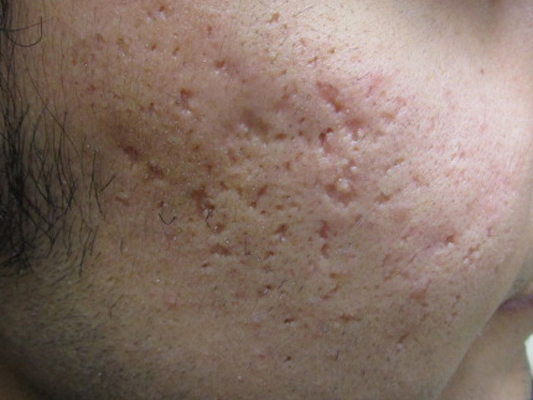
TCA-CROSS is most effective for appropriately selected icepick and boxcar scars. In our experience, shallower icepick scars and many boxcar scars often respond particularly well. Very deep, narrow icepick scars may show less improvement and sometimes are better treated with procedures such as punch excision.
Rolling scars often respond better to subcision, while broader boxcar scars may benefit from punch elevation or laser resurfacing. During your consultation, each scar is carefully evaluated so the most appropriate treatment can be selected.
Our Approach to TCA-CROSS
TCA-CROSS is one of the procedures we perform most frequently for appropriately selected acne scars. Our goal is not simply to treat every scar, but to identify those that are most likely to improve.
Because every patient’s scars are different, treatment is individualized. Some patients achieve excellent improvement with TCA-CROSS alone, while others benefit from combining it with subcision, punch techniques, or fractional CO₂ laser resurfacing as part of a comprehensive treatment plan.
Recovery and Results
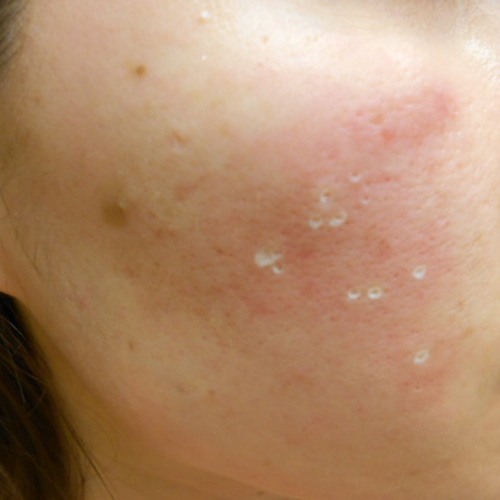
Immediately after treatment, the treated scars develop a temporary white frosting followed by tiny scabs over the next day. These scabs are an expected part of the healing process and usually remain for about one week before naturally separating.
Temporary redness is common as the skin heals. Patients with darker skin tones have a greater tendency to develop temporary post-inflammatory hyperpigmentation (PIH), although this usually fades over time. Careful sun protection is important after treatment, and in selected patients, a prescription lightening cream may be recommended before and/or after the procedure to help reduce this risk.
Although the surface heals relatively quickly, collagen remodeling continues beneath the skin for several months. As a result, improvement develops gradually, and additional treatments often provide further benefit depending on your response. Treatments are typically spaced several weeks apart to allow the skin to respond before additional treatment is considered.
Why Experience Matters
Although TCA-CROSS appears straightforward, successful treatment requires more than simply placing acid into a scar. Selecting the appropriate concentration, applying it precisely within the scar while avoiding the surrounding skin, recognizing which scars are unlikely to respond, and determining when additional treatments are appropriate all influence the final outcome.
For this reason, Dr. Berlin recommends TCA-CROSS only when it is likely to provide meaningful improvement and often combines it with other procedures when doing so is expected to produce a better overall result.
Frequently Asked Questions
Can TCA-CROSS remove acne scars completely?
No. The goal is meaningful, natural-looking improvement rather than perfection. Most patients notice that treated scars become significantly less noticeable, although some irregularities may still be visible on close inspection.
Does TCA-CROSS work on old acne scars?
Yes. The age of the scar is usually much less important than its shape and depth. Even scars that have been present for many years may improve with TCA-CROSS if they are appropriate candidates for treatment. During your consultation, each scar is evaluated individually to determine whether TCA-CROSS is likely to be beneficial or whether another procedure may be more effective.
Can TCA-CROSS be combined with other procedures?
Yes. Many patients benefit from combining TCA-CROSS with subcision, punch excision or punch elevation, or fractional CO₂ laser resurfacing to address different scar types during an individualized treatment plan.
How many TCA-CROSS treatments will I need?
Some patients achieve excellent improvement after one or two treatments, while others benefit from additional sessions. Rather than recommending a predetermined treatment package, we evaluate your progress after each procedure and allow your results to guide the next step.
Will the treated scars form scabs?
Yes. Small scabs are an expected part of healing and usually remain for approximately 7-10 days. They should be allowed to heal naturally, as collagen remodeling continues beneath the skin long after the surface has healed.
Can TCA-CROSS be performed safely on darker skin?
TCA-CROSS can often be performed safely in patients with darker skin tones because the treatment is confined to individual scars rather than the entire skin surface. However, darker skin has a greater tendency to develop temporary post-inflammatory hyperpigmentation (PIH) after almost any procedure. Careful patient selection, precise technique, appropriate sun protection, and, in some cases, topical lightening creams help minimize this risk.
If you are considering TCA-CROSS for acne scars, we will carefully evaluate your scars, determine whether TCA-CROSS is appropriate for your specific scar types, and discuss whether combining it with other procedures is likely to provide the greatest improvement.