
Subcision has become one of the most important procedures in modern acne scar treatment and is often considered the treatment of choice for appropriately selected rolling acne scars that remain tethered beneath the skin. Rather than simply improving surface texture, subcision addresses one of the underlying structural causes of many depressed scars by releasing the fibrous bands that pull the skin downward.
Many patients researching acne scar treatment eventually learn about subcision because it is one of the most effective treatments for rolling acne scars. During your consultation, we determine whether subcision is appropriate for your scars, whether other scar types are also present, and whether subcision should be performed alone or combined with other procedures as part of a comprehensive treatment plan.
What Is Subcision?
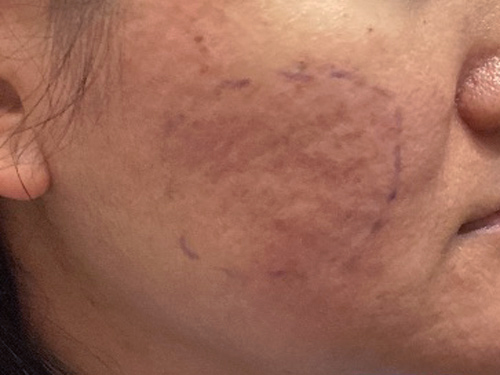
Marker indicates treated area.
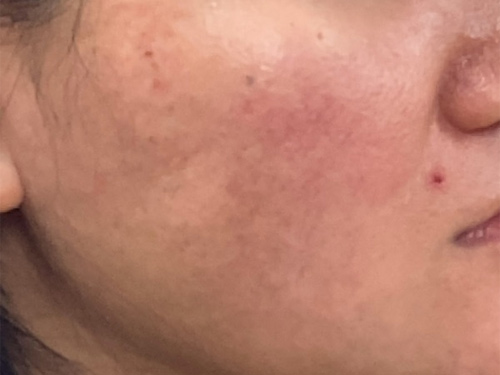
Individual results vary.
Subcision literally means “cutting under.” It is a minimally invasive surgical procedure designed to treat rolling acne scars that remain attached to deeper tissues by fibrous scar bands. A specialized instrument is inserted beneath the skin through a tiny entry site to carefully release these attachments.
Releasing the tethering allows the depressed scar to move more freely while stimulating the body’s natural healing response beneath the skin. Over the following weeks and months, new collagen develops within the treated area, helping improve skin contour. Because subcision addresses one of the underlying structural causes of many acne scars, it often produces improvements that resurfacing procedures alone cannot achieve.
Who Is a Good Candidate?
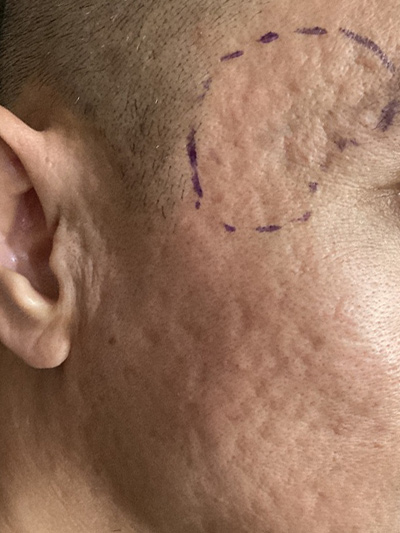
These broad depressions are tethered beneath the skin and are often excellent candidates for subcision.
Subcision is most effective for rolling acne scars that appear as broad, gently sloping depressions and remain tethered beneath the skin by fibrous scar bands. Patients with these scars often notice improvement immediately after the procedure, with continued improvement as collagen remodeling occurs over the following months.
Most patients have several different scar types on the same face, and not every depressed scar benefits from subcision. Boxcar scars, icepick scars, enlarged pores, and textural irregularities often respond better to other procedures or a combination of treatments.
During your consultation, each scar is carefully evaluated to determine whether subcision is likely to improve it and whether additional procedures may be recommended to address other scar types.
Our Approach to Subcision
Subcision has become one of the cornerstone procedures in Dr. Berlin’s approach to treating appropriately selected acne scars because it addresses one of the underlying structural causes of many depressed scars. Rather than viewing it as an isolated procedure, it is incorporated into a comprehensive treatment plan designed around each patient’s specific scar pattern and treatment goals.
Some patients achieve meaningful improvement after a single session, while others benefit from staged treatments performed over time as collagen remodeling occurs. Treatment recommendations are based on your progress rather than a predetermined treatment package.
Subcision is frequently combined with TCA-CROSS, punch excision or punch elevation, and fractional CO₂ laser resurfacing when additional scar types are present, allowing each procedure to address the scars for which it is best suited.
In selected patients who also have significant facial volume loss, injectable fillers or biostimulatory treatments such as Sculptra may occasionally be used to restore facial volume separately from the treatment of the acne scars themselves.
Recovery and Results
Most patients experience temporary swelling and bruising after subcision. The amount varies depending on the extent of treatment, and bruising can occasionally be significant. These effects are expected and gradually improve over the following days to weeks.
Although some improvement is often noticeable once the initial swelling has resolved, collagen remodeling continues beneath the skin for several months. As a result, the full benefit of treatment develops gradually, and additional improvement may continue long after the procedure.
Rather than recommending a predetermined number of treatments, Dr. Berlin reassesses your progress after each session. Additional procedures are recommended only when they are expected to provide meaningful improvement.
Why Experience Matters
Although subcision appears straightforward, achieving consistent results requires more than simply passing an instrument beneath the skin. It depends on recognizing which scars are truly tethered, selecting the appropriate treatment plane, releasing enough scar tissue to improve the depression, and knowing when further release is unlikely to provide additional benefit.
As a fellowship-trained Mohs surgeon, Dr. Berlin routinely works with facial anatomy, scar tissue, and surgical reconstruction. That reconstructive experience influences his approach to subcision, emphasizing thoughtful patient selection, precise technique, and conservative treatment planning. The goal is not simply to perform more procedures, but to recommend the treatment most likely to improve the scars that remain.
Frequently Asked Questions
What types of acne scars respond best to subcision?
Rolling acne scars that remain tethered beneath the skin typically respond best. Not every depressed scar requires subcision, which is why a careful examination is important.
Can subcision be combined with other procedures?
Yes. Many patients benefit from combining subcision with TCA-CROSS, punch excision or punch elevation, or fractional CO₂ laser resurfacing to address different scar types.
How many subcision treatments will I need?
Some patients achieve excellent improvement after a single treatment, while others benefit from additional sessions. Rather than recommending a predetermined treatment package, we evaluate your progress after each procedure and let your results guide the next step.
When will I see improvement?
Initial healing occurs over the first several weeks, but collagen remodeling continues for several months. Improvement develops gradually over time.
Will I have bruising?
Temporary swelling and bruising are common after subcision and are expected parts of the healing process. The extent varies from patient to patient and depends on the area treated.
If you are considering subcision for acne scars, we will carefully evaluate your scars, discuss whether subcision is appropriate for your specific situation, and determine whether it should be performed alone or combined with other treatments to achieve the best possible improvement.