
Acne scars can be one of the most frustrating consequences of acne, especially when previous treatments have provided only limited improvement. While many people think of acne scars as simply a skin texture problem, different scars form in different ways. Some are tethered beneath the skin, others are narrow and deep, and others primarily affect surface texture. Because of these differences, no single treatment is best for every patient.
Fortunately, advances in acne scar surgery and resurfacing now allow many patients to achieve meaningful, long-lasting improvement. Rather than recommending the same procedure for everyone, we carefully evaluate each scar type and develop an individualized treatment plan. In many cases, the best results are achieved by combining complementary procedures over time, with progress reassessed after each treatment rather than following a predetermined series.
Many patients come to our practice after previous treatments have provided only limited improvement. Our goal is not simply to perform another procedure, but to identify why certain scars have persisted and select the treatment—or combination of treatments—most likely to improve them.
Why Acne Scars Can Be Difficult to Treat
Acne scars are permanent structural changes within the skin that develop after inflammation disrupts the normal collagen framework. Some scars form because collagen has been lost, while others remain tethered to deeper tissues by fibrous bands that pull the skin downward. Many patients have several different scar types at the same time, making treatment considerably more complex than simply improving skin texture.
Because different scars develop in different ways, there is rarely a single treatment that is appropriate for every patient. Successful treatment begins with identifying the type of scar present and understanding what is causing it. Once that is determined, the treatment—or combination of treatments—most likely to improve each scar can be selected.
Understanding Different Types of Acne Scars
Most facial acne scars are atrophic (depressed) scars, meaning that collagen loss during healing leaves the skin with permanent depressions. These include rolling, boxcar, and icepick scars. Less commonly, acne can produce hypertrophic (raised) scars or keloids, which develop from excessive collagen production. This is more common on the upper back, chest, and shoulders, but can also occur on the face.
Because different acne scar types respond to different procedures, successful acne scar treatment often requires more than one technique. Additionally, most patients have several different scar types at the same time. Although the distinction is not always obvious, identifying the type of scar is one of the most important steps in selecting the treatment most likely to improve it. Some patients also have enlarged pores, uneven skin texture, persistent redness, or discoloration that may require a different treatment approach than the scars themselves.
Rolling Scars
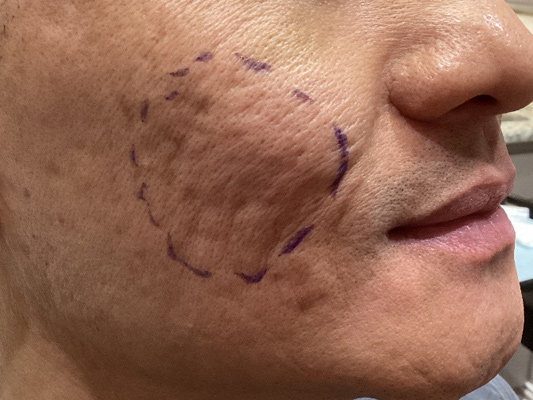
Rolling scars are gently sloping depressions that are often tethered beneath the skin by fibrous bands. Because of this tethering, treatments that simply resurface the skin typically provide only limited improvement if the underlying attachments are not first released. Because subcision releases these underlying attachments, it is often one of the most effective treatments for rolling scars.
Boxcar Scars
These are broader depressions with relatively well-defined edges. Treatment depends largely on the depth of the scar. Shallower boxcar scars may respond well to laser resurfacing, while deeper scars may benefit from TCA-CROSS, punch elevation, subcision if tethered, or a combination of these procedures.
Icepick Scars
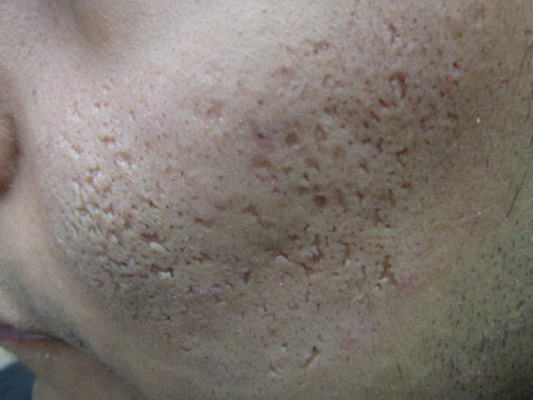
These are narrow, deep, sharply defined scars that often respond best to TCA-CROSS when relatively superficial or to punch excision when deeper.
Hypertrophic Scars
Unlike the three previous categories of scars, hypertrophic scars and keloids develop because the skin produces too much collagen during healing. Because these scars form through a different healing process, treatment is also different and may include intralesional corticosteroid injections, silicone therapy, vascular or resurfacing laser treatment, or other approaches that help to reduce excess collagen and flatten the scar.
Treatment Options
Modern acne scar treatment often involves combining complementary procedures, each selected to address a specific type of scar.
Subcision
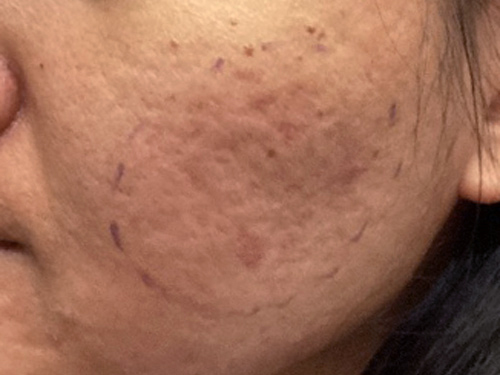
Marker indicates treated area.
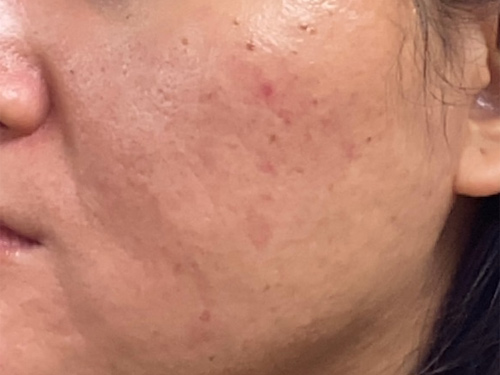
Individual results vary.
Subcision is often the treatment of choice for rolling acne scars that remain tethered beneath the skin by fibrous scar tissue. By carefully releasing these fibrous bands, the skin is able to elevate while the body’s natural healing response gradually produces new collagen beneath the treated area. In many patients, additional procedures may then be used to address other scar types.
TCA-CROSS
TCA-CROSS uses carefully placed high-strength trichloroacetic acid to stimulate new collagen formation within selected icepick and deeper boxcar scars. Because collagen remodeling occurs gradually, improvement develops over time and multiple treatment sessions are often recommended.
Punch Excision and Punch Elevation
Punch excision and punch elevation are minor surgical techniques that may improve carefully selected deep scars that are unlikely to respond adequately to collagen stimulation alone.
Acne Scar Revision
Occasionally, an acne scar is too large, wide, or irregularly shaped to be treated effectively with punch excision or other standard acne scar techniques. In selected cases, surgical scar revision, including staged excision when appropriate, may be used to replace or reshape a broad or irregular scar into a smaller or less noticeable scar.
Laser Resurfacing
Fractional CO₂ laser resurfacing improves overall skin texture and softens the transition between scars and surrounding skin. Because it cannot release tethered scars or reliably correct deeper structural defects, it is often performed after treatments such as subcision or TCA-CROSS have addressed those problems.
Fillers and Volume Restoration
Injectable fillers may be useful in selected patients with depressed acne scars or underlying facial volume loss. Rather than routinely using filler to temporarily correct individual scars, we generally prefer treatments that address the underlying scar itself. However, when facial volume loss contributes to a sunken or depressed appearance, volume restoration may complement treatments such as subcision.
Although many patients search for a specific procedure such as subcision or TCA-CROSS, successful acne scar treatment begins with identifying the type of scar being treated rather than choosing a procedure first. Because most patients have more than one type of scar, combining several complementary treatments often produces better results than relying on a single technique.
Why an Individualized Treatment Plan Matters
One of the most common questions we hear is, “What is the best acne scar treatment?”
In reality, the better question is, “What is the best treatment for this particular scar?”
We do not believe there is a single procedure that is right for every patient, nor do we recommend predetermined treatment packages. Every patient’s scars, skin, and healing response are different. Rather than following a predetermined series of procedures, we reassess your progress after each treatment. If improvement continues, the procedure may be repeated. If progress begins to plateau, another treatment that addresses the remaining scars more effectively may be recommended instead.
Our goal is not to perform the greatest number of procedures, but to recommend the right procedure at the right time based on your individual scars. The best treatment depends on the scar—not on a single device or technique. By matching each scar to the treatment most likely to improve it, we strive to achieve the best possible result while avoiding unnecessary procedures.
What to Expect
Improving acne scars is usually a gradual process rather than a single event. Although individual procedures may take only minutes to perform, collagen remodeling continues beneath the skin for several months after each treatment, and improvement develops gradually over time.
Some patients achieve excellent improvement after only one or two procedures, while others benefit from a series of treatments. Because every patient heals differently—and because treatment recommendations may change as your scars improve—it is not possible to accurately predict the exact number of treatments needed before treatment begins.
Our goal is meaningful, natural-looking improvement rather than perfection. Treatment is typically continued only while each procedure is expected to provide worthwhile additional improvement. Once the remaining scars become mild enough that further treatment is unlikely to justify the additional cost, recovery, or risk, treatment often concludes.
Why Choose Dr. Berlin for Acne Scar Treatment
Although acne scar treatment is considered cosmetic, the scars themselves often represent reconstructive problems. Successful treatment requires understanding how scars form beneath the skin and selecting procedures that address the underlying structural changes rather than simply improving surface texture.
As a board-certified dermatologist and fellowship-trained Mohs surgeon, Dr. Alexander Berlin has spent over 19 years reconstructing complex facial defects following skin cancer surgery. That reconstructive experience shapes his approach to acne scars. Rather than relying on a single device or technology, he applies reconstructive principles and a broad range of surgical and nonsurgical techniques to develop individualized treatment plans.
Every consultation, procedure, and follow-up visit is performed personally by Dr. Berlin, allowing treatment decisions to evolve as your scars improve while providing continuity of care throughout the process.
The goal is not to perform more procedures, but to recommend the right procedure at the right time for the scars that remain.
Frequently Asked Questions
Can acne scars be completely removed?
No. The goal of treatment is meaningful, natural-looking improvement rather than perfection. Most patients notice that their scars become significantly less noticeable under normal conversational lighting, although minor irregularities may still be visible under close inspection or harsh lighting.
Whenever possible, active acne should be well controlled before beginning acne scar treatment to reduce the risk of developing new scars during treatment.
How do I know which treatment is right for me?
The best treatment depends on the type of acne scars you have. Rolling scars, boxcar scars, and ice-pick scars often respond best to different procedures, and many patients have more than one scar type. During your consultation, we will carefully evaluate your scars and recommend an individualized treatment plan based on your specific findings.
How many treatments will I need?
There is no predetermined number of treatments that is appropriate for every patient. Some patients achieve excellent improvement after only one or two procedures, while others benefit from additional treatments. Rather than recommending a fixed treatment package, we reassess your progress after each procedure and let your results guide the next step.
Can different procedures be combined?
Yes. Most patients have several different types of acne scars, so combination treatment often produces better results than relying on a single procedure. Depending on your scars, treatment may include subcision, TCA-CROSS, punch excision or punch elevation, fractional CO₂ laser resurfacing, or a combination of these techniques.
I have already had laser treatments. Can I still benefit from treatment?
Often, yes. Many patients come to our practice after undergoing previous treatments elsewhere. In some cases, the previous treatment simply did not address the particular type of scar being treated. During your consultation, we will review your treatment history and discuss which treatment options may still be beneficial.
I have heard about subcision. Is it right for me?
Subcision is one of the most effective treatments for rolling acne scars that remain tethered beneath the skin. However, not every depressed acne scar is tethered, and many patients have several different scar types on the same face. During your consultation, we will determine whether subcision, another procedure, or a combination of treatments is most likely to improve your scars.
Schedule a consultation to discuss your options and find the most effective treatment plan for your skin.